

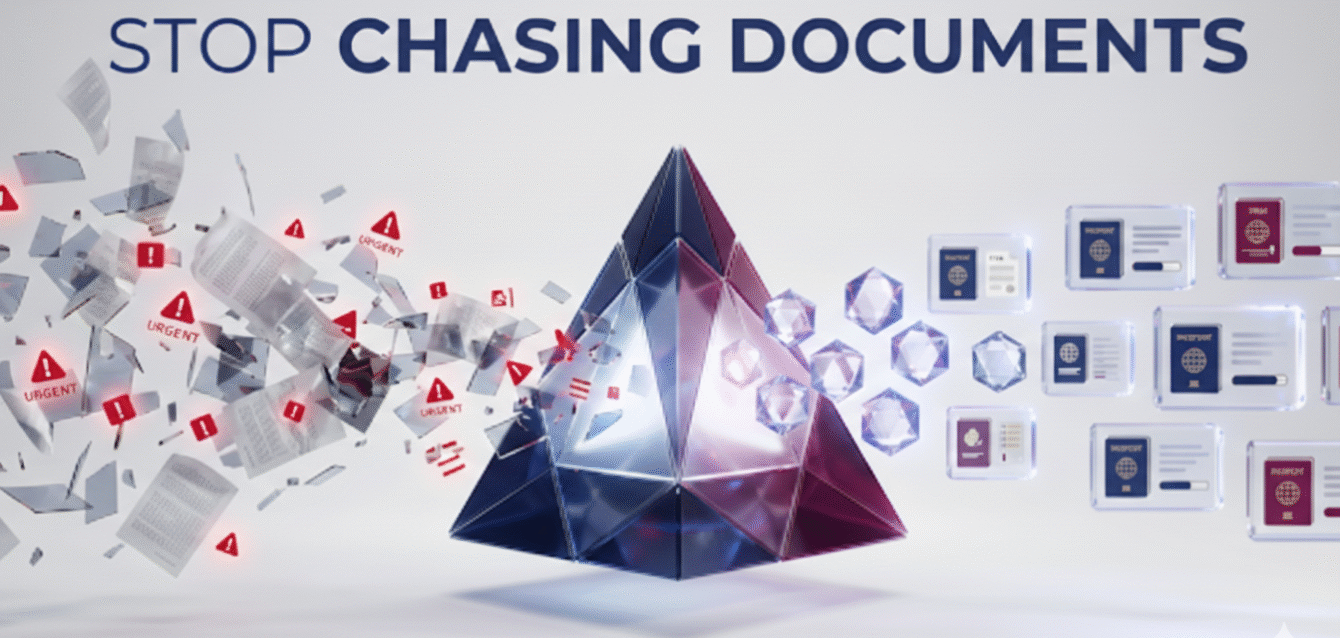
How to Stop Chasing Clients for Immigration Documents
If you are an immigration consultant, chances are a large part of your week is spent chasing documents. Emails, reminders, follow-ups, and “just one more file” requests quietly consume hours that should be spent on real case work.
Document collection automation for immigration consultants is the use of structured upload portals, automated reminders, and real-time tracking to gather client files without manual follow-ups. It eliminates the back-and-forth that drains productivity and delays case timelines.
This problem is not caused by unresponsive clients. It is caused by document workflows that were never designed for clarity, accountability, or scale.
This article explains how immigration consultants can stop chasing clients for documents by redesigning document collection systems, safely and compliantly. This approach is part of Barrana’s AI Automation for Immigration Consultants framework, built specifically for RCICs in Ontario and across the Greater Toronto Area.
Why Do Immigration Consultants Spend So Much Time Chasing Documents?
Most immigration firms rely on outdated collection methods:
- Email attachments scattered across inboxes
- Shared folders with no structure or naming conventions
- Verbal instructions that clients forget
- Static checklists in PDF or Word format
From the client’s perspective, this creates confusion:
- They do not know what documents are still missing
- They do not know what to submit next
- They do not understand which files are most urgent
From the consultant’s perspective, visibility is limited:
- No real-time status across cases
- No consistent file structure
- No clear accountability for outstanding items
When RCICs lack structured systems, chasing documents becomes inevitable. The College of Immigration and Citizenship Consultants (CICC) expects consultants to maintain organized files, but disorganized collection makes this difficult from the start.
How Much Time Do Immigration Firms Lose to Document Follow-Ups?
Each follow-up email seems small. Two minutes here. Five minutes there.
But multiplied across 20, 30, or 50 active cases, document chasing consumes significant time:
- 5 to 8 hours per week spent on document-related follow-ups
- 30 to 45 minutes per case clarifying missing items
- 3 to 5 emails per client before receiving complete packages
This fragmented time loss is hard to see because it happens in small bursts throughout the day. But the cumulative impact is real:
- Breaks focus on substantive case work
- Delays IRCC submission timelines
- Increases risk of errors and missed documents
- Creates frustration for both consultants and clients
Immigration consultants often do not realize how much time is lost until they track it deliberately.
Why Generic File Sharing Fails for Immigration Document Collection
Clients do not think in workflows. They think in fragments.
When asked to “send the required documents,” clients typically:
- Upload partial document sets
- Send outdated versions of files
- Use unclear or inconsistent filenames
- Forget what they already submitted
- Mix documents across family members
This is not negligence. It is ambiguity. Generic tools like Dropbox, Google Drive, or email attachments do not provide the structure immigration cases require.
Worse, these tools create compliance risk. PIPEDA requires appropriate safeguards for personal information. Uncontrolled file sharing through consumer tools may not meet the security standards expected of regulated professionals.
For Express Entry, Provincial Nominee Programs, or family sponsorship applications, the document requirements are specific and extensive. Generic file sharing cannot enforce the structure these applications demand.
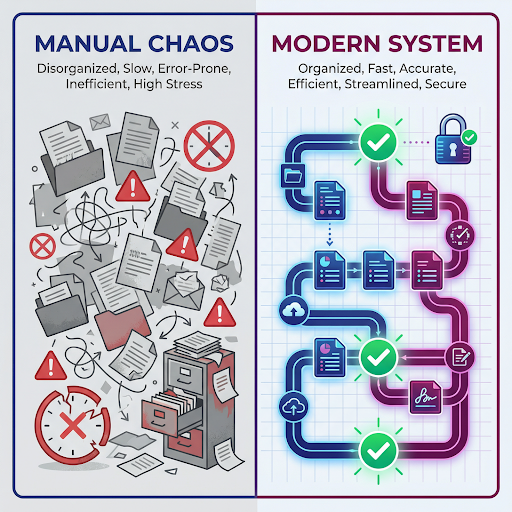
What Does a Proper Document Collection System Look Like?
A modern immigration document collection system provides clarity at every step:
For Clients:
- Clear checklist showing exactly what is required
- Visual status indicators (submitted, pending, missing)
- Specific instructions for each document type
- Mobile-friendly upload from any device
For Consultants:
- Real-time dashboard showing collection status across all cases
- Automated reminders for outstanding documents
- Consistent folder structure and file naming
- Integration with case management tools like INSZoom or Docketwise
The system creates clarity, not pressure. Clients know exactly what to do. Consultants know exactly where each case stands.
This approach connects directly to document collection software for immigration consultants that Barrana builds for firms across Ontario.
How Can Immigration Consultants Automate Document Collection Safely?
Automation does not mean removing human oversight.
Safe document automation means:
- Structured requests with clear requirements per document type
- Controlled uploads through secure, encrypted portals
- Validation rules for file formats and sizes
- Human review checkpoints before any document is used in an application
Safe document automation does NOT mean:
- Letting AI read or interpret legal documents
- Removing human verification steps
- Storing files in unsecured consumer tools
- Allowing uncontrolled access to client data
Consultants stay in control at every step. The system handles collection and organization. You handle professional review and judgment.
This principle aligns with RCIC compliant AI tools, automation that supports your work without creating compliance risk.
Common Document Automation Mistakes to Avoid
Immigration firms run into trouble when they:
Use generic file-sharing tools — Dropbox and Google Drive lack immigration-specific features like document checklists and status tracking.
Allow unstructured uploads — When clients can upload anything with any filename, organization becomes your problem.
Skip verification steps — Documents should be reviewed before being added to case files. Automation should flag issues, not hide them.
Mix documents across cases — Without proper segregation, files from one client can accidentally appear in another client’s folder. This creates serious compliance risk.
Ignore security requirements — PIPEDA applies to immigration consultants. Document systems must use encryption, access controls, and proper data handling.
Good systems reduce follow-ups. Bad systems create silent risk that surfaces at the worst time.
How Document Collection Connects to Your Full Workflow
Document collection does not exist in isolation. It works best when integrated with your complete client workflow:
Before Document Collection: Client intake automation captures the information that determines which documents are needed. Structured intake means accurate document checklists.
After Document Collection: Immigration application form automation uses the collected documents to verify data and populate IRCC forms accurately.
Throughout the Process: Automated client updates notify clients when documents are received, when items are still missing, and when action is required.
This connected approach is part of Barrana’s AI Automation for Immigration Consultants framework, designed specifically for RCICs who need efficiency without compliance risk.
If your firm is spending too much time cleaning intake data instead of reviewing cases, we can map one intake workflow and show what safe automation could look like for your practice.
Common Concerns from Legal ProfessionalsFAQs
Most immigration consultants lose 5 to 8 hours every week chasing missing or incorrect documents. This includes reminder emails, follow‑ups, and reorganizing files that arrive in the wrong format.
The easiest way is a secure client document portal with clear checklists and status tracking. Clients can see exactly what’s required, and consultants can instantly see what’s missing — without email back‑and‑forth.
Yes — when done correctly. Safe document automation uses encrypted uploads, access controls, and human review. Client documents should never be processed through public AI tools or unsecured file‑sharing platforms.
No. Most clients actually find portals easier than email because they know exactly what to upload and when. Mobile‑friendly portals reduce confusion and missed documents.
Common documents include passports, language test results (IELTS or CELPIP), education credentials, employment letters, proof of funds, police certificates, medical results, and IRCC‑specific forms. The exact list depends on the immigration pathway.
Stop Chasing Documents. Start Collecting Them Automatically.
If your firm is losing 5 to 8 hours per week to document follow-ups, there is a better way.
We can map one document workflow for your practice and show exactly how to eliminate chasing, without increasing compliance risk.
What you will get:
- Analysis of your current document collection process
- Identification of specific bottlenecks and time drains
- Custom recommendations for your practice areas
- Clear roadmap for implementation