

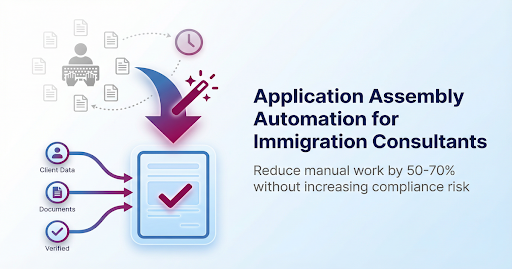
Application Assembly Automation for Immigration Consultants
How to Reduce Manual Work Without Increasing Compliance Risk
Application assembly automation for immigration consultants is the use of structured data systems to pre-fill IRCC forms, organize supporting documents, and prepare complete application packages, without re-entering client information multiple times.
For many RCICs in Ontario and the Greater Toronto Area, assembling applications is one of the most time-consuming parts of the workflow. You re-enter the same client details across multiple forms. You cross-check documents manually. You copy information that already exists somewhere else in your files.
This manual process slows down case progress and increases the risk of small errors that can delay IRCC submissions.
The good news: immigration form automation can cut this work by 50 to 70 percent—while keeping you in full control of every application.
Why Does Application Assembly Take So Long?
Most immigration firms still rely on disconnected workflows:
- Client intake forms are separate from case files
- Documents are scattered across emails, folders, and drives
- The same information gets typed into IRCC forms again and again
- Verification happens multiple times because data is not linked
Even when client information already exists, it often has to be entered manually, again.
This is not inefficiency from consultants. It is a workflow design problem.
For a typical Express Entry or Provincial Nominee Program application, consultants can spend 3 to 5 hours just on data entry and form filling. For firms handling 20+ cases per month, that adds up to entire work weeks lost to repetitive typing.
What Does Application Assembly Automation Actually Mean?
Let’s be clear: automation does not mean letting AI submit applications or make eligibility decisions.
IRCC form automation simply means:
- Capturing client data once and reusing it across forms
- Organizing documents in a structured, consistent way
- Pre-filling repetitive fields (names, dates, addresses, passport numbers)
- Keeping human review checkpoints before anything is submitted
You stay fully responsible for accuracy, strategy, and compliance.
Automation supports the process. It does not replace your expertise.
Why Do Immigration Consultants Spend So Much Time Chasing Documents?
When immigration case preparation automation is structured properly, the benefits add up quickly:
Less Repetitive Data Entry
Client information is captured once, during intake, and flows into forms automatically. No more typing the same passport number into five different fields.
Faster Application Preparation
Consultants spend more time reviewing strategy and less time typing. Most firms see a 50 to 70 percent reduction in form-filling time.
Fewer Errors
When data comes from one verified source, mistakes from re-typing decrease dramatically. Some firms report an 80 percent reduction in data entry errors.
Better Client Experience
Applications move faster. Updates are clearer. Clients feel the difference when their case progresses smoothly. For busy RCIC practices in Ontario, these improvements free up hours every week for higher-value work.
Is RCIC Workflow Automation Compliant?
This is the question every immigration consultant should ask before automating anything.
The short answer: yes, if designed correctly.
A compliant automated immigration applications system includes:
- Secure client data handling — encrypted storage, controlled access
- Clear audit trails — you can see exactly what happened and when
- Human verification checkpoints — the consultant reviews and approves before submission
- No unauthorized AI decisions — automation organizes data; you make professional judgments
This approach works within CICC professional expectations and Canadian privacy standards under PIPEDA.
The key principle: automation should reduce administrative burden without introducing compliance risk.
How Does Application Assembly Fit the Full Workflow?
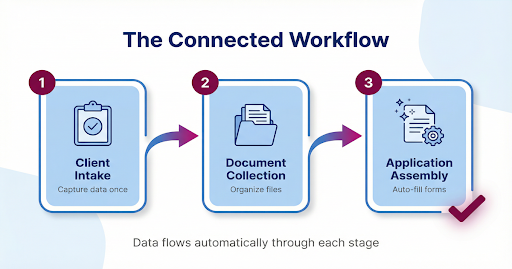
Application assembly automation works best when connected to earlier stages of your workflow:
Step 1: Client Intake Automation Structured forms capture complete, verified client information from the start.
Step 2: Document Collection Automation Supporting files arrive organized, correctly named, and easy to reference.
Step 3: Application Assembly Automation Verified data flows into IRCC forms. Documents attach in the right order. The consultant reviews and approves.
When these pieces connect, workflows become predictable instead of reactive. You stop chasing information and start moving cases forward.
This connected approach is part of Barrana’s AI Automation for Immigration Consultants framework.
What Mistakes Do Immigration Firms Make with Automation?
Some firms struggle because they:
Use generic tools — Software built for any business rarely handles immigration-specific requirements like IRCC form formats or pathway-specific document lists.
Skip structured intake — If client data is messy at intake, assembly automation just moves messy data faster. Garbage in, garbage out.
Over-automate without human review — Removing verification checkpoints creates compliance risk. Every application should be reviewed before submission.
Store documents inconsistently — When files are scattered and poorly named, automation cannot help.
Good systems reduce effort. Poor systems simply shift the chaos.
How Can Immigration Consultants Start with Application Assembly Automation?
Most firms do not need a complete overhaul to see results. Start small:
- Pick one application type you handle frequently Express Entry, study permits, or spousal sponsorship, choose the one you do most often.
- Standardize your intake fields Make sure you capture all the data needed for that application type upfront.
- Structure your document collection Create a checklist specific to that pathway. Organize files consistently.
- Introduce safe data reuse Pre-fill forms using verified client information. Review before submitting.
Small workflow improvements often deliver quick wins, and build confidence for larger changes.
If your firm is spending too much time cleaning intake data instead of reviewing cases, we can map one intake workflow and show what safe automation could look like for your practice.
Common Concerns from Legal ProfessionalsFAQs
Application assembly automation is the use of structured data systems to pre-fill IRCC forms, organize supporting documents, and prepare complete application packages without re-entering client information multiple times. Consultants still review and approve everything before submission.
Yes, when designed with compliance in mind. Safe systems include human review checkpoints, secure data handling aligned with PIPEDA requirements, and clear audit trails. Automation handles data organization while you retain full professional responsibility.
Immigration consultants typically save 50 to 70 percent of form-filling time. For a typical Express Entry application, this can mean saving 2 to 4 hours per case on data entry and document organization.
Yes. Automation systems can pre-fill common IRCC forms like IMM 0008, IMM 5669, and Schedule A using verified client data. You still review every form before submission.
Most immigration firms can implement basic automation in 3 to 5 weeks, including workflow mapping, field setup, template creation, and testing.
Ready to Reduce Your Application Assembly Time?
If your firm spends hours re-entering the same client information across IRCC forms, there is a better way.
We can map your application assembly workflow and show exactly where automation saves time, without adding compliance risk.
What you get:
- Analysis of your current application process
- Identification of repetitive data entry points
- Custom recommendations for your practice areas
- Clear roadmap for implementation
Barrana.ai builds AI automation for immigration consultants in Ontario and the Greater Toronto Area. We help RCICs reduce admin work while staying compliant with CICC and PIPEDA requirements.